Pep2Net-DB
174,825 peptide records · 422,021 assay records · public database cross-references and literature · functional annotations · structure prediction & dataset export.
Statistics snapshot: · Version 20261118T130
Core database modules
Grouped entry points for search, browsing, analysis, and export.
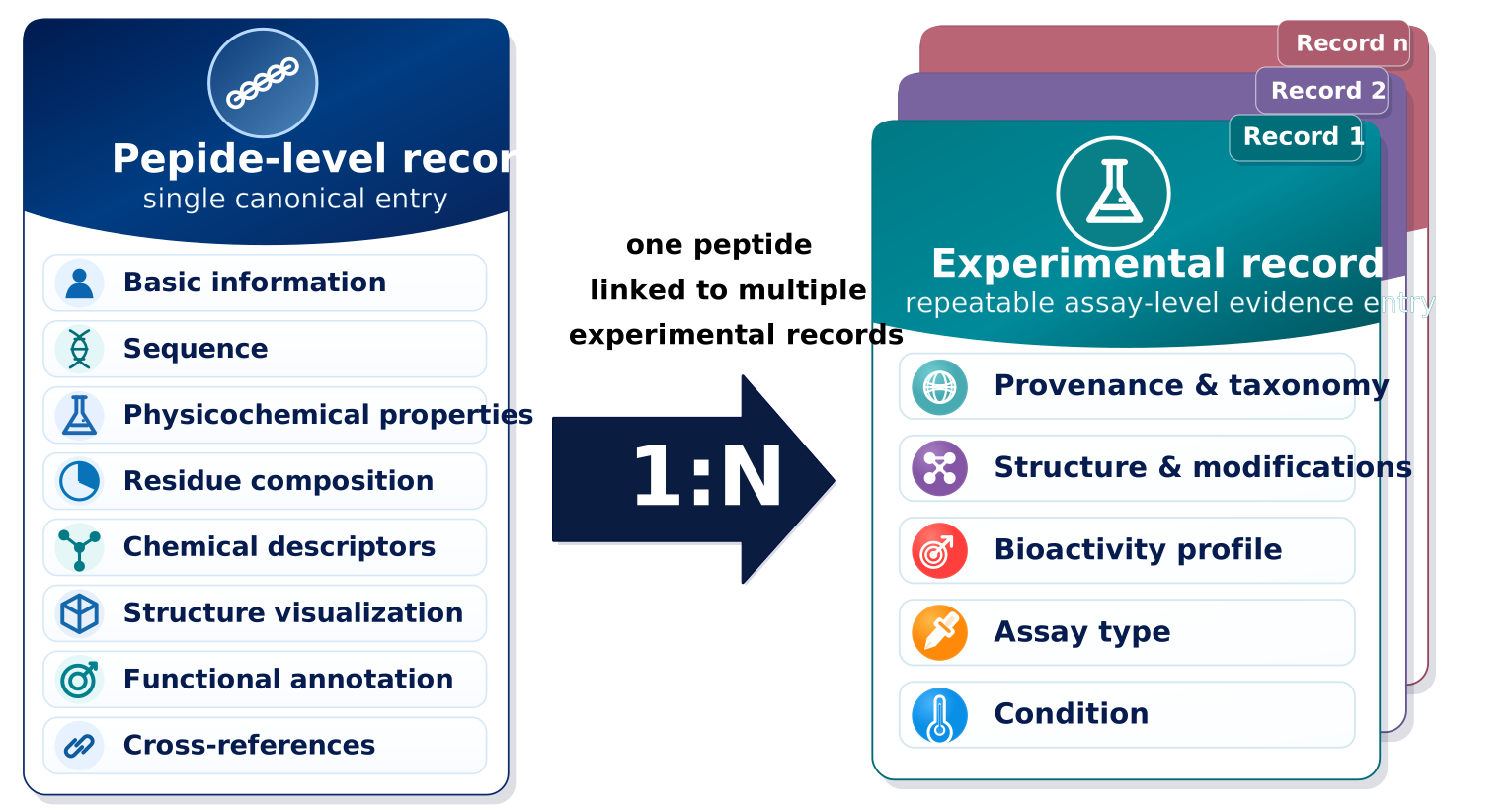
Missing image: static/svg/one to more2.svg
One peptide record can connect to many observations.
The database separates stable peptide attributes from experimental context, so records stay easier to filter, compare, and export.
From heterogeneous sources to a unified knowledgebase.
Public databases, patents and literature are cleaned, normalised, functionally mapped and cross-validated before serving through the web platform.
Historical workflow illustration: numbers within the diagram describe an earlier release. Current totals are shown in the statistics snapshot above.
The workflow diagram could not be loaded. Open diagram

ESM-2 + GATv2 Model Architecture
All function prediction models share a unified backbone: ESM-2 protein language model produces per-residue embeddings, which are processed by GATv2 graph attention layers to capture long-range residue interactions. Bundle models (Toxicity / Antiviral) output multiple labels simultaneously; single-label models are optimised per functional category.
